Getting the most out of cvscored
cvscored works best as one routine for every job you apply to. Find or add a job, score it, adapt your CV and letter, prepare, and keep track.
 The cvscored team
Check your CV against a job. Free, no account.
Add your CV and the job. You see your match score and how far it can rise.
We never train AI on your CV. Hosted in Germany under GDPR.
Contents
Step by step
Add your CV once
Upload the CV you already have, or paste its text. Check that we read your jobs, lines and skills correctly.
Find or add a job
Search jobs by title and place inside cvscored, or add a job by its link or text. The extension saves jobs from job pages.
Score your CV against the job
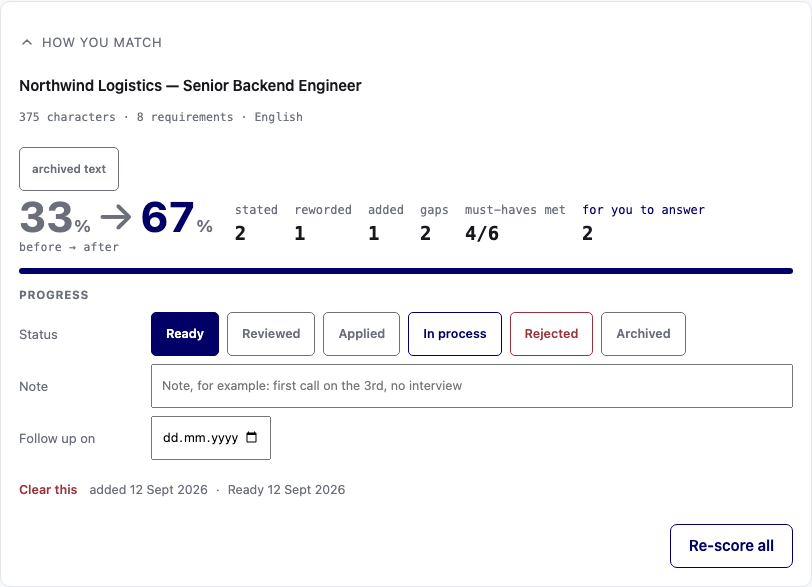
You see each requirement, the line of your CV that answers it, and the gaps. Two numbers show the score now and after rewording.
Adapt the CV for this job
Switch to the employer's word where your line means the same. Fill a gap with "I have this" only if you have done the work.
Write the letter
Start from your CV, or from a letter you wrote before. Edit the draft until it sounds like you.
Build the PDFs and apply
Pick a layout and the language, build the CV and the letter, and send the application yourself.
Prepare and keep track
Practise the likely questions, set a follow-up date, and move the stage as you hear back.
Start with one good CV
Everything else is built on the CV you add. A clear CV gives a clear score.
Write your real jobs, dates and results. Put a number in a line where you have one.
The structure score checks the shape of your CV: a profile line, three to six lines per job, dates and headings.
You keep one main CV. Changes made for one job go into that job's CV only.
Choose jobs worth the time
Score a job before you spend an evening on it. The score and the gaps tell you if it is a near fit.
A close match is worth tailoring. A far one is a sign to spend the time on another job.
Jobs for you lists openings that fit your CV and the job you are looking for.
Saving a job is free. Score it when you are ready to decide.
Adapt without inventing
Rewording uses the employer's word for work you have done. Both versions are shown, and you choose.
A gap you can honestly fill becomes a new line, written from what you tell us.
A gap you cannot fill stays open. The letter or the interview is the place to talk about it.
Requirements only you can answer, such as travel or on-call, are not counted in the score.
Letters and form questions
The letter starts from your CV and the posting. Each application adds its own points.
If you have a letter you like, upload it. We tidy layout, spelling and grammar, not what it says.
Paste the questions from an employer's form. Each answer is drafted from your CV and saved with the application.
The CV and letter can be written in English, German, French, Italian, Spanish or Dutch.
After you send
Move the stage as things happen: applied, in process, interview, offer, or a no.
Set a follow-up date. On the day, one email lists what is due.
Interview prep keeps every answer you saved, so your best wording is ready for the next job.
If you want, add your salary anonymously to see where it stands for similar roles.
Lena Hoffmann's week with cvscored
Lena Hoffmann is the made-up person in our examples. Here is one invented week of her job search.
| Day | Step | What she did |
|---|---|---|
| Monday | Find | Searched for backend jobs in Berlin and saved four. |
| Monday | Score | Scored two of them. Northwind Logistics was the closest match. |
| Tuesday | Adapt | Switched two lines to Northwind's wording and kept her main CV as it was. |
| Tuesday | Letter | Drafted the letter from her CV and rewrote the first paragraph in her words. |
| Wednesday | Apply | Built both PDFs in English and applied on Northwind's own form. |
| Thursday | Prepare | Practised the three hardest likely questions. |
| Friday | Track | Set a follow-up date for the next week. |
An invented example.
Good points
- One routine for every job.
- Your main CV stays untouched.
Not so good
- Each step still needs your judgement.
- You send each application yourself.
Checklist
- Your CV is added and reads correctly.
- Each job is scored before you spend time on it.
- Rewording changes words, never facts.
- Your main CV is unchanged.
- The letter sounds like you.
- The PDFs open and are in the right language.
- Every application has a stage and a follow-up date.
One honest limit
cvscored prepares your application. It does not apply for you, and it cannot know what the employer decides.
Key takeaways
- Start with one clear CV.
- Score first, then decide.
- Change wording, not facts.
- Track every stage and follow up.
Frequently asked questions
- Do I need to use every step?
- No. Use only the steps that save you time. Scoring and tailoring alone already help.
- What does scoring a job cost?
- Scoring a job uses one application. Searching for jobs and saving them are free.
- Will my main CV change?
- No. Changes for one job go into that job's CV. Your main CV stays as it is.
- Can I use cvscored on my phone?
- Yes. The app works in a phone's browser. The extension needs Chrome or Edge on a computer.
- Which languages can I use?
- The app is in ten languages. The CV and letter are written in six: English, German, French, Italian, Spanish and Dutch.
- Does cvscored apply for me?
- No. You send each application. On supported sites the extension can fill in the form with your details for you to check.