Cover letter generator
A first draft for one job, written from your CV and the posting. Then it is yours to edit, line by line, before it goes out.
 The cvscored team
Check your CV against a job. Free, no account.
Add your CV and the job. You see your match score and how far it can rise.
We never train AI on your CV. Hosted in Germany under GDPR.
Contents
- Step by step
- A letter for this employer
- A letter for a career change
- The first sentence does the work
- Your own letter sets the tone
- Your signature, your document
- The order of a good letter
- What to leave out
- Write it even when the advert says optional
- Lena Hoffmann's opening lines
- Checklist
- One honest limit
- Key takeaways
- Frequently asked questions
- Related guides
Step by step
Start from the advert
Put the advert and your CV in first. A letter written from both answers the job in front of you. A letter from a template answers no one.
Name the role and the company
Write the exact role title and the company name in the first lines. Check the spelling against the advert.
Answer the top requirement first
Find the requirement the job cares about most. Open your letter with the work you have done that answers it.
Use one real example
Give one example with a result you can defend. A number or a named project beats a list of skills.
Say why this company
Add one true sentence about the company or the team. It shows you read past the title.
Read it once as the employer
Cut any sentence that could go to any employer. Keep the letter to one page, then read it aloud once.
Keep a copy for the interview
Save the letter with the application. Interviewers often ask about the sentence that interested them. The copy tells you what you promised.
A letter for this employer
The draft answers the advert in front of you.
It draws on the experience already in your CV.
It uses the employer's own words where they fit your work.
Every paragraph should point at a requirement. If it does not, cut it.
A letter for a career change
A career change needs a bridge, not an apology.
Name the skill that carries over and the proof that it does.
Say in one sentence why you are moving now.
Then give the example that shows the new work is not new to you.
Keep the rest short. The bridge is the letter.
The first sentence does the work
Most readers decide in the first two lines whether to read on.
Put the role, the company and your strongest fact in that order.
Do not open with a question and do not open with a quote.
A plain sentence beats a clever one every time.
If you cannot write the first line, borrow it from the advert.
Your own letter sets the tone
Add a letter you have written before and the draft follows its tone.
Leave that box empty and the draft is written from your CV alone.
You can change every line before you send it.
The tone matters more than most people think. A calm, plain letter reads as confidence.
Your signature, your document
Draw a signature or upload a picture of one.
The letter is built as a real PDF with your name and signature on it.
You can also send the letter as plain text.
Check the PDF once. A name spelled wrong at the top undoes a good paragraph below.
The order of a good letter
Open with the role, the company and the one thing you bring.
Give one real example with a result in the middle.
Close with a short, calm sentence and your name.
Three or four paragraphs are enough. Nobody reads a page for pleasure.
What to leave out
Leave out the line about being passionate. Say what you did instead.
Leave out the summary of your whole CV. The letter is not the CV.
Leave out anything you cannot back up with a story.
Leave out the apology. You are applying, not asking a favour.
Write it even when the advert says optional
A short letter shows you read the advert and can order your points.
Keep it short. Three or four paragraphs are enough.
If you truly have nothing to add, a short letter is better than a long one.
The letter is a draft. You review and edit everything before you send it.
Lena Hoffmann's opening lines
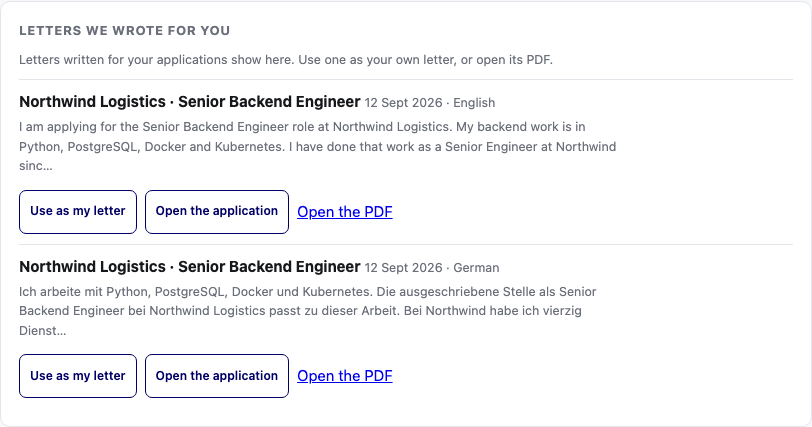
Lena applies for the Senior Backend Engineer role at Northwind Logistics. The draft opens with the work that answers the advert.
I am applying for the Senior Backend Engineer role at Northwind Logistics. My backend work is in Python, PostgreSQL and Kubernetes. I rebuilt a dispatch platform on Kafka, cutting the median assignment time from nine seconds to under one for 40,000 daily deliveries. I led a team of eleven engineers across Berlin and Lisbon.
An invented example.
Good points
- Starts from your real experience.
- Saves the blank page on a busy day.
Not so good
- A draft still needs your edit.
- It cannot know the person who will read it.
Checklist
- The first line names the role and the company.
- The spelling of the company name is checked.
- At least one example has a result.
- No sentence could go to a different employer.
- The letter is one page or less.
- The PDF opens and shows the signature.
- You kept a copy with the application.
- You read the letter aloud once.
One honest limit
The letter is a draft. Read every line as the employer and change what does not sound like you, because you sign it.
Key takeaways
- Open with the employer's need.
- Keep the letter to one page.
- Edit the draft in your own voice.
- Write it even when the advert says optional.
Frequently asked questions
- Does the draft use my CV?
- Yes. It is written from your CV and the posting, and you edit it before sending.
- Can I use my own letter as a starting point?
- Yes. Add it and new drafts follow its tone and reuse your sentences.
- Will the letter have my signature?
- Yes, if you add one. You can draw it or upload a picture of it.
- Is the letter in my language?
- Letters are written in six languages: English, Deutsch, Français, Italiano, Español and Nederlands. The letter is built from the CV in that language.
- How much does it cost?
- Your first 3 applications are free, with every feature, and need no card. For more, you buy a plan. A free account keeps your letters.
- Should I write a letter if the advert says optional?
- A short honest letter often helps. Keep it to one page and answer the main requirement.