Interview questions
The questions this job may ask, drawn from the posting, the company and what people reported. Then prepare the answers before the day.
 The cvscored team
Check your CV against a job. Free, no account.
Add your CV and the job. You see your match score and how far it can rise.
We never train AI on your CV. Hosted in Germany under GDPR.
Contents
- Step by step
- Questions from the posting
- If you blank in the room
- The interview is a conversation
- Questions about the company
- Questions people reported
- Say it in two minutes
- Questions you ask them
- The week before
- Practise, then record
- Lena Hoffmann prepares three answers
- Checklist
- One honest limit
- Key takeaways
- Frequently asked questions
- Related guides
Step by step
List the requirements that worry you
Open the advert and the match. The weakest requirements are the questions you will most likely be asked. Start there.
Draft one answer per requirement
For each one, write a short story from your CV. Name the situation, what you did, and the result. A result with a number is easy to remember.
Prepare the company questions
Read the company's own pages. Write two questions about the team, the product or the first ninety days.
Practise out loud
Say each answer once, out loud. A story told once is easier to tell again. Time the longest one at about two minutes.
Ask your own questions
Prepare three questions for the interviewer. They show you are choosing the job too, not only hoping.
Note what you were asked
After the interview, write down the questions you got. They help with the next job and with the same company.
Plan the practical things
Check the address, the time and the video link the day before. Charge your phone and keep a printed CV in the bag. Small things calm a room.
Questions from the posting
The app reads the advert and your CV together.
It drafts the questions an interviewer would build from them.
The weakest requirements become the questions to rehearse first.
A requirement you meet in other words is a question about both words.
If you blank in the room
Take one slow breath and ask for a moment. It is normal.
Repeat the question in your own words to buy a second.
Start with the situation, even if the result is not ready in your head.
The story usually finds its end once it has started.
If you truly do not know, say so and say how you would find out.
The interview is a conversation
You are there to find out about them as well.
Answer, then ask, then listen. Listening is half of it.
If an answer goes badly, let it go. The next question is a new chance.
Thank them for the time and ask when you will hear back.
A calm conversation beats a perfect script every time.
Questions about the company
The company's own facts become questions too.
Each question is tagged with where it came from.
Read the last two years of news before you go, not the last ten.
Know what the company sells, to whom, and how it makes money.
Questions people reported
Where people have reported interview questions, the app searches for them.
A reported question carries a link to the page it came from, so you can read it.
Not every company has reports yet. The questions from your scoring are still there.
Treat a reported question as a hint, not a script. The interviewer may ask it differently.
Say it in two minutes
Name the situation in one sentence, so the listener has a frame.
Say what you did, in the first person. Use the word I.
Give the result, and use a number if you have one.
Stop. Silence is fine, and the next question will come.
If the story runs long, the interviewer stops listening for the point.
Questions you ask them
Ask what the team is trying to finish in the first six months.
Ask how the team decides what to build next.
Ask what happened to the person in the role before.
Their answers tell you as much as your own did, so listen closely.
The week before
Re-read the advert and your tailored CV, side by side.
Rehearse the three stories you use most, out loud, twice.
Prepare one question about pay, and ask it late, not first.
Sleep more than you think you need. A tired answer sounds like a weak one.
Practise, then record
Open a question and write the example you would tell.
Say it out loud once. A story told once is easier to tell again.
After the interview, note what you were asked. It helps with the next job.
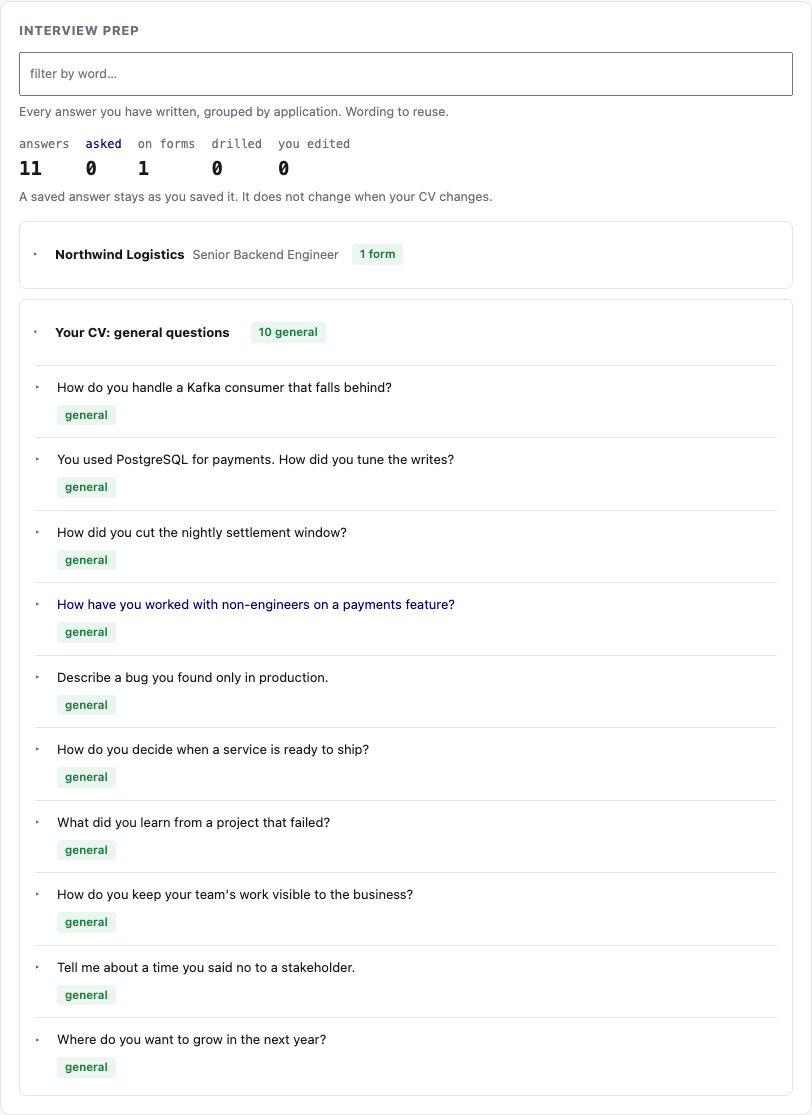
Over time your saved answers become a personal interview guide.
Lena Hoffmann prepares three answers
Lena sorts the questions by how likely they are. She writes one story for each and says it out loud.
| Question | Where it comes from | What it tests |
|---|---|---|
| Why did you pick Kafka for the platform? | Her CV | A choice she can defend |
| Tell me about a deployment that broke production. | The posting | Honesty under pressure |
| How do you lead a team of eleven? | Her CV | The work behind the title |
An invented example.
Good points
- Groups questions by where they come from.
- Keeps your answers for the next job.
Not so good
- A reported question is a hint, not a script.
- The interviewer may ask it in another way.
Checklist
- The three weakest requirements have an answer.
- Each answer names a situation, an action and a result.
- The longest answer is about two minutes.
- Two company questions are ready.
- Three questions for the interviewer are ready.
- The address and time are checked.
- A printed CV is in the bag.
- You plan to note the questions afterwards.
One honest limit
These are likely questions, not a leak. No one knows the real questions, so use them to rehearse your own true stories.
Key takeaways
- List the requirements that worry you first.
- Write one short story for each.
- Say the longest answer out loud at two minutes.
- Prepare three questions of your own.
Frequently asked questions
- Where do the questions come from?
- The posting, the company, and questions people reported, plus a few general ones.
- Are these the real questions?
- They are likely questions, not a leak. They come from the advert and your CV.
- Can I save my answers?
- Yes. Each answer is kept under its application, so you can reuse the wording.
- Does it work in my language?
- Yes, in all ten languages, including English, German and French.
- How much does it cost?
- Your first 3 applications are free, with every feature, and need no card. For more, you buy a plan. A free account keeps your answers.
- How long should an answer be?
- About two minutes. Long enough for one story, short enough to stay interesting.