CV and job match
See how closely your CV fits one job, and which of your lines did the work. The score is one number, and it moves when the wording changes.
 The cvscored team
Check your CV against a job. Free, no account.
Add your CV and the job. You see your match score and how far it can rise.
We never train AI on your CV. Hosted in Germany under GDPR.
Contents
- Step by step
- A number out of 100
- What the match counts
- Where the number moves
- A close match is not a win
- The score and the software that reads first
- A worked week with the score
- When a low score is the answer
- The score over time
- Lena Hoffmann raises a match
- Checklist
- One honest limit
- Key takeaways
- Frequently asked questions
- Related guides
Step by step
Read the score as a share
The score is the share of the advert your CV already answers. It is out of 100, so 67 means about two thirds of the requirements.
Read the second number
The second score is what the same CV could reach in the employer's words. The gap between the two is what your wording is worth.
Find the lines that did the work
Under the score you see each requirement and the CV line behind it. Keep these lines. They are the strongest part of your application.
Look at the gaps
A gap is a requirement no line answers. A gap you can close honestly is the best thing to fix first.
Use the employer's words
Where your CV means the same thing in other words, the app shows both phrases. Adopt the employer's word only when the meaning is the same.
Run the match before the effort
Match before you write a letter or rewrite the CV. A close match is worth the evening. A far one tells you to look elsewhere.
Compare two jobs before you choose
Run the same CV against two adverts. The scores tell you where your evening is best spent. Most people apply to the job they found last, not the one that fits best.
A number out of 100
The match is the share of the advert your CV already answers.
Next to it is the score the same CV could reach in the employer's words.
The two numbers sit side by side, so you see what the wording is worth.
The difference is not a trick. It is the work your CV already did, said in the employer's language.
What the match counts
Each requirement is checked and marked essential or nice to have.
Requirements your CV cannot answer are left out, not counted against you.
That keeps the number honest for a job that asks for something impossible.
A commitment only you can make is left out too. The score cannot answer it.
The score is about the advert in front of you, not about you as a person.
Where the number moves
Add a line you missed and the score follows.
Use the employer's word where your CV already means the same thing.
The app shows both phrases before you change anything.
Fixing the top requirement moves the score more than fixing five small ones.
Numbers and tools move it fastest, because they are easy to check.
A close match is not a win
A high score means your CV fits the advert. It does not mean you have the job.
Employers weigh interviews, references and timing as well.
The match is a reason to apply, not a promise of anything.
A strong interview can beat a higher score, and often does.
The score and the software that reads first
Many employers use software to sort applications before a person sees them.
That software often looks for the words in the advert, not the meaning.
Using the employer's word where it is true helps here as well.
It does not help to list a word you cannot explain, because a person reads next.
The match shows you the words, and the interview checks the meaning.
A worked week with the score
On Monday, run the match and read the gaps.
On Tuesday, rewrite two lines in the employer's words.
On Wednesday, run it again and watch the number move.
On Thursday, write the letter from the lines that did the work.
On Friday, send it and start again on the next advert.
When a low score is the answer
A score in the twenties is the app telling you something.
It may mean the advert wants a different job, a different seniority or a different country.
It may also mean your CV is good but written in your own words, not the market's.
Read three gaps before you give up. They usually say which of the two it is.
The score over time
Your score on one advert is a snapshot. Your score across ten is a pattern.
If the same gap appears in every advert, that is the thing to learn next.
If the scores rise with the wording, your experience was there all along.
Keep the adverts and the scores, and the pattern shows within a week.
Lena Hoffmann raises a match
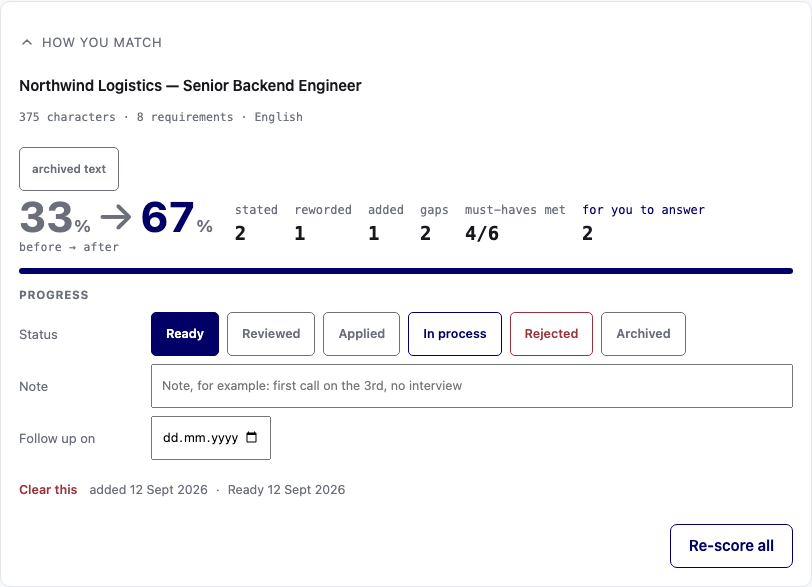
Lena starts at 33. Two requirements are covered, and two are gaps. She adds one honest line, adopts two of the employer's words, and the score nearly doubles.
| What the score counts | Before | After the wording |
|---|---|---|
| Requirements already covered | 2 | 4 |
| Requirements to reword | 0 | 2 |
| Gaps | 2 | 0 |
| Match score | 33 | 67 |
An invented example.
Good points
- Separates must-haves from nice-to-haves.
- Shows the line that did the work.
Not so good
- It cannot know the team or the budget.
- A long advert asks for more than one person has.
Checklist
- The advert has at least five clear requirements.
- The score is read together with the list of gaps.
- Every changed line keeps its original meaning.
- The dates and titles are unchanged.
- You compared at least two adverts.
- The strongest lines are near the top.
- You know which gap you cannot close.
- You decided whether the score is worth an evening.
One honest limit
A high score is not a win. The employer interviews people, checks references and chooses on the day, and the number cannot see any of that.
Key takeaways
- Read the score with its list, never alone.
- Must-haves carry the most weight.
- A close match is worth an evening.
- A low score can be the useful answer.
Frequently asked questions
- Is the match score an interview promise?
- No. It shows how much of the advert your CV covers. The employer decides who to interview.
- Why are two numbers shown?
- The first is what your CV answers today. The second is what it answers in the employer's words.
- Can I raise the score?
- Yes. Fill a gap or use the employer's wording, and the score moves.
- Is the match free?
- Your first 3 applications are free, with every feature, and need no card. Create an account to keep the score and the CV.
- Which jobs does it work for?
- Any job with a written advert, in any of the ten languages.
- What is a good score?
- Around 60 and above is worth applying for. Below that, read the gaps before you spend the evening.
- Does the score compare me with other people?
- No. It compares your CV with one advert. It does not rank you against anyone else.