Keyword-stuffed or proof-matched: two ways to write a CV for one job
A stuffed CV repeats the words of the job advert. A proof-matched CV answers each requirement with a line of real work. Here is why the second one reads better.
 The cvscored team
Check your CV against a job. Free, no account.
Add your CV and the job. You see your match score and how far it can rise.
We never train AI on your CV. Hosted in Germany under GDPR.
Contents
Step by step
List the requirements
Read the advert and write down each skill, tool and kind of experience it asks for. Mark the ones it calls essential.
Find your proof for each one
For every requirement, find the line in your CV that shows you have done it. A line of proof names the work, the tool and, where you can, a result.
Use the employer's word where it is true
If your line says the same thing in other words, use the advert's word. Change the wording, never the facts.
Leave the gaps as gaps
A requirement with no proof stays open. Do not add the keyword to a skills list to hide it. Decide whether to explain it in the letter.
Cut the repeats
Remove words that appear only to be found: long keyword lists, the same tool named five times, hidden text. Each one weakens the lines around it.
Read it as a person would
Read each job entry aloud. If a line would make a recruiter ask "where did you do that?", rewrite it until it answers the question.
What keyword stuffing looks like
Keyword stuffing means filling a CV with the advert's words so that software or a quick reader finds them.
- A skills block with thirty tools, half of them used once.
- The same phrase in the profile, in every job and again in a list at the end.
- The advert's sentences copied in, sometimes in white text so no one sees them.
- Job titles changed to the advert's title, although the work was different.
It is tempting, because the advice you read online is often about keywords. It also feels safe: the words are all there.
Why it reads badly to software
Hiring software reads a CV file and puts its parts into fields: name, education, experience, skills.
Many of these tools then search the text for keywords, and also for related terms. Recruiters filter the results by skills, experience or languages.
Text taken out of a file has no colour. White words become ordinary words in the record a recruiter opens.
A long keyword list says nothing about where or when you used a skill. A filter may find you, and the next step is a person reading.
Designed files with tables, columns or graphics are harder for some of these tools to read. A plain layout is the safer choice.
Why it reads badly to a person
A recruiter who opens your CV checks one thing first: can this person do the work in the advert?
A keyword answers "have you heard of it". A line of proof answers "have you done it".
Repeated words make the real lines harder to find. The reader has to dig for the job you did.
A title or a skill that the interview cannot confirm costs more than a gap. People remember it.
What a proof-matched CV looks like
Each requirement in the advert has one line in your CV that answers it.
That line names what you did, with which tool, and what changed because of it.
Where your words differ from the advert's, you use the advert's word, because it means the same thing.
Skills appear where you used them, inside the job entry, not only in a list.
Gaps stay visible to you. You decide whether to explain them, learn the skill, or apply somewhere else.
How cvscored helps
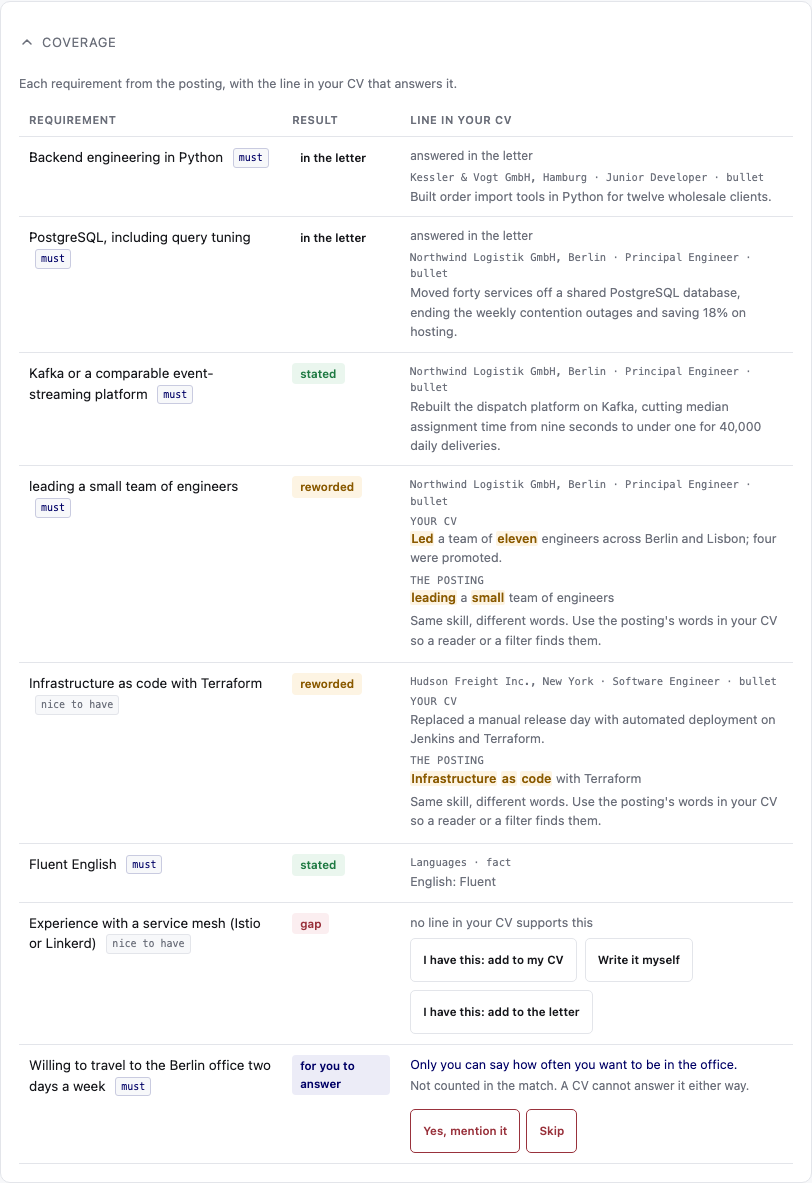
cvscored reads the advert, pulls out each requirement, and looks for the line of your CV that answers it.
You see the requirement, the result and that line side by side. A requirement only you can answer, such as travel, stays out of the score.
Where your line says the same thing in other words, you see both versions and choose.
A gap stays a gap. If you have done the work, press "I have this", and a line is written from what you did.
Lena Hoffmann: three requirements, two ways
Lena Hoffmann is the made-up person in our examples. She applies to a made-up job at Northwind Logistics.
| Requirement | Stuffed line | Proof-matched line |
|---|---|---|
| Kafka or a comparable event-streaming platform | Skills: Kafka, Kafka Streams, event streaming, streaming platforms, Kafka | Rebuilt the dispatch platform on Kafka for 40,000 daily deliveries. |
| PostgreSQL, including query tuning | PostgreSQL expert, query tuning, database tuning, PostgreSQL | Moved forty services off a shared PostgreSQL database and ended the weekly outages. |
| Leading a small team of engineers | Team leader, leadership, people leadership, leading teams | Led a team of eleven engineers across Berlin and Lisbon. |
| Infrastructure as code with Terraform | Terraform | No line yet: a gap she names in her letter. |
An invented example.
Good points
- Each requirement is easy to find and check.
- Nothing in it falls apart in the interview.
Not so good
- It takes longer to write than a list.
- It shows your gaps as plainly as your strengths.
Checklist
- Each essential requirement has one line of proof.
- Each line names the work, the tool and a result.
- The advert's word is used only where it is true.
- No skill is listed that you have not used.
- No word appears only to be found.
- No hidden or white text is left in the file.
- Every gap is one you can explain honestly.
One honest limit
A proof-matched CV makes your fit easy to see. It cannot change the fit itself, and the employer still decides who to invite.
Sources
Checked on .
- HR WORKS, HR glossary: CV parsing (in German): hrworks.de/lexikon/cv-parsing/
Key takeaways
- One requirement, one line of proof.
- Use the advert's word only where it is true.
- Leave gaps visible and decide what to do about them.
- Cut words that are there only to be found.
Frequently asked questions
- Is it wrong to use the advert's words?
- No. Use them where your work matches. The problem starts when the words stand in for work you have not done.
- Does hiring software reject CVs without the right keywords?
- It depends on how the employer set it up. Many systems let recruiters search and filter. A person usually decides.
- Should I hide keywords in white text?
- No. Hiring software reads the text, not its colour. The hidden words show up in the record a recruiter reads.
- How long should my skills list be?
- Short. Name the tools you can talk about in an interview. Show the rest inside the job entries where you used them.
- What if I really lack a requirement?
- Leave it open. Say in the letter how you would close it, or choose a job that fits better.
- Does cvscored add keywords for me?
- No. It shows which line answers each requirement. It suggests the employer's word only where your line already means the same.